Monday, April 21, 2025

Gen Con, April 2025: the joy and the hurt. Then, the redemptive message of Easter!

General Conference was unusual this time around. First, I was the only one home for a couple of the sessions, and I was so buried in work that I tried to multitask by grading essays as I listened to the talks. This didn't work well. I didn't get the full impact of the talks, and my grading was inefficient <sigh>. That is until the amazing Sister Tamara Runia took the stand Sunday morning. From the time she opened her mouth to speak until she pronounced "Amen" and returned to her seat, I was captured. There is a culture that permeates our Church (though not doctrinal) that the way to get blessings is to do more stuff. That slippery slope can lead to a false belief, whether conscious or not, that doing more stuff will somehow make us more acceptable to God and that any mistakes we make along the way define us and will be held against us. Sister Runia kick ball-changed that nonsense right to the curb, as she invited us to ignore the voice that tells us to "hide" and instead, to "bravely believe in Christ. Walk over to him and turn on the Light." There we go. That's the God I worship. 

Well, after her remarks, I returned to my listening/grading mode, waiting for Elder Patrick Kearon's turn to speak. I had to wait a long time, as he was the third to last speaker Sunday afternoon. The wait was worth it. This guy never disappoints. Dovetailing on Sister Runia's message, Elder Kearon asked us to reflect on what it means to receive God's gift. When we recognize and remember our heritage as precious daughters and sons of deity, we are transformed. "When you welcome this majestic reality into your very soul and feel both the comfort and thrill of it, your entire paradigm shifts!" Indeed! And then my favorite part, the best part, really. Again, pushing back against the culture of having to do stuff in order to be loved by God, Elder Kearon asks and answers that question directly: "You may be wondering, 'What do I have to do to receive this gift from God?' Well, actually, nothing. It is a gift from the Giver. It is simply a fact. Just let it in...Don't complicate it." Whoa, nothing? I know it seems too good to be true. That's why people struggle to believe it and add a bunch of caveats, restrictions, and rules. But in this particular case, "too good to be true" is actually false. Praise God!

Now, I pause to explain. I've written about General Conference many, many times. Never have I written about talks that troubled me. Never have I been quite this troubled. Saturday afternoon, before either of these two God-centered, grace-affirming talks, I heard another one. And this one hurt me. And I have to talk about it. When Elder Neil L. Anderson began his remarks and his topic became clear, I knew I would likely disagree with at least some of what he said. No worries. I disagree with the official position of the Church on several issues. Nothing in my membership in the Church or in my covenants as a member requires me to agree with every position the Church takes or every comment its leaders make. On this particular issue, I support a woman's right to choose what she does with her own body; her reproductive healthcare choices are hers alone. The Church takes the position that elective abortion should be prohibited, other than in circumstances of rape, incest, or serious threat to the life of the mother. We disagree. That's okay.

Why then was I so hurt by Elder Anderson's words? It wasn't because of his stance on elective abortion, but rather one example he used to support his position. I couldn't come up with a more outrageous, misogynist example if I tried! He tells the story of a woman, who learns that her husband has cheated on her, and the outcome is the pregnancy of another woman, who was then considering an abortion. The wife begs this woman to carry the pregnancy to term in order to prevent the abortion, promising that she will raise the child as her own. First, let me say that this wife's actions are fine if that's what she feels called to do. The problem is that an apostle speaking in General Conference presented this choice as the most faithful, righteous, and even "saintly" one. 

Uh, no. 

I will never face these circumstances, but if I did, I can tell you with 100% certainty what I would do. I would wish my husband well (and mean it!), but my marriage would end. Pregnancy or no pregnancy, this would be a deal-breaker. Be clear. I have no desire to be called "saintly." Hard pass on that. I'll remain my regular, mistake-making self. But my own personal boundaries would not allow the marriage to continue. You see, I'm the cherished daughter of Heavenly Parents and also beloved by the Savior of the whole world! So I am worthy of better. And I would certainly feel no responsibility for a pregnancy that was the result of my husband's adulterous affair. Her business. Her choice.

I think the hurt I felt as I listened, incredulously, to this talk was for other women who have experienced similar circumstances, those whose personal boundaries and values led them to end their marriages and move on. Elder Anderson at least implied that they are not quite as faithful or righteous as the wife in his story. How very sad for them. 

Alas, in the same month as General Conference comes Easter, with its glorious message of grace, redemption, and joy! I will hold fast to that message. I will stick with Sister Runia, who teaches me that my worth can never change, regardless of what I do, because I literally belong to God. And with Elder Kearon, who reminds me that the best gift ever was already given, and I don't have to do a single thing to earn it, because it is already mine.

Friday, October 11, 2024

Reverence does not equal quiet (and other cool stuff I heard last weekend)!

I was not raised in The Church of Jesus Christ of Latter-day Saints, so when I find myself baffled by the culture of this religion (and yes, I'm often baffled, especially here in Utah), I simply remind myself, "Yeah....I'm a convert. So that makes zero sense to me."

One piece of church culture that I've never understood is the idea that you have to be quiet in order to be reverent or to feel God's spirit. The most reverent times in my life are usually anything but quiet. When my four kids who live here in the Valley are all home at the same time with their friends and families, it is loud and raucous, often chaotic and boisterous. 

And also perfect! 

When I witness the four of them together, inside jokes and hilarious memories, such close friends with such different personalities, I'm in awe of the love and grace they extend to each other. It is, for me, the epitome of reverence. Tears are welling in my eyes even now, as I write about it. I feel so blessed that all four of them still wanna hang with me, even though they no longer have to. I am the luckiest! And the reverence I feel for my Heavenly Parents, who trusted me with these precious souls, is most notable when they are all together, in spite of the noise level. 

So last weekend, in the Saturday morning session of General Conference, when Elder Patrick Kearon taught that "We are members of the Church of Joy," and that joy should be most obvious when we "gather to worship the source of all joy," I might have jumped right out of my bed, clad in my most comfiest "pajama church" clothes, and shouted, "PREACH, brother!" Then he went on to explain (and demonstrate!) that, while the culture of  "folding our arms tightly around our chests, bowing our heads, closing our eyes, and holding still---indefinitely!" might be helpful when teaching children, as we mature, we discover that "reverence is so much more." 

Well by this point in the talk I had two epiphanies. First, I was overwhelmed with gratitude for this new apostle, whose feelings resonate so perfectly with my own. Perhaps it's because he joined the church as a young adult, just like I did? And second, this is why callings in Primary have never been a great fit for me. I refuse to insist that children, after sitting for a full hour in a silent, not-so-joyous sacrament meeting, be forced to do the same thing for yet another hour. Or to tell them that if they don't, they're not being reverent. Their very presence is reverent. They are so new from Heaven that they radiate God's grace simply by being! So no, I won't ask them to fold their arms, bow their heads, or be still. 

In the spirit of Dissoi Logoi, I should acknowledge that there is clear doctrine to describe how in some cases, quiet is needed in order to hear the Spirit, 1 Kings 19:11-13, for example. And yes, I honor those experiences from scripture and from people today, who testify that in the quietest of times, they hear God's whisperings. But there are other times when the Spirit is compared to a "rushing mighty wind" (Acts 2:2). However we experience God's spirit is incredible, and there are as many ways, times, and places to experience it as there are people. If we seek God, God will respond in the perfect way for our unique needs. And however that happens, it will be reverent. 

I also really enjoyed Elder Karl D. Hirst's talk. He spoke on one my most cherished topics: being God's favorite! I expressed my own feelings about being God's favorite in my post to this blog back in April, called "Dissoi Logoi: A "Truthier Truth," so it was pretty cool to hear someone echo my feelings in General Conference. Comparing God's love to circles on a Venn diagram, Elder Hirst taught that "God's love is where we all overlap. Whichever parts of us seem different, His love is where we find togetherness.

Wow! Does that send shivers up your spines, too? Whoever you are, wherever you are, whatever your circumstances, you are God's favorite! You are loved with a power and purity stronger and greater than you can even imagine. I think this concept is sometimes challenging to grasp because it seems too good to be true. Most often when things seem too good to be true, it's because they aren't true. But the love of our Heavenly Parents and our Savior is the exception. Indeed, that kind of love, that radical grace seems way too good to be true. And yet.....it is true! 

And you don't even have to be quiet to feel it.

Sunday, September 22, 2024

Musings on Psalms 23


The Lord is my shepherd; I shall not want.

He maketh me to lie down in green pastures: he leadeth me beside the still

waters.

He restoreth my soul: he leadeth me in the paths of righteousness for his name’s

sake.

Yea, though I walk through the valley of the shadow of death, I will fear no evil:

for thou art with me; thy rod and thy staff they comfort me.

Thou preparest a table before me in the presence of my enemies: thou anointest

my head with oil; my cup runneth over.

Surely goodness and mercy shall follow me all the days of my life: and I will dwell

in the house of the Lord forever.


Psalms 23 is one of the most well-known chapters in the Old Testament and

arguably the most well-loved of all the Psalms of David. For good reason. It

speaks comfort, hope, and joy directly to our souls, as it reveals the very

character of Christ. Let’s look at it together.


The Lord is my shepherd; I shall not want.

In Biblical times, a shepherd, oftentimes even a child, was tasked with tending

the sheep, which were valuable resources for the family. So important were these

sheep, that the shepherd would stay with them day and night to make sure they

were properly fed, watered, and protected from harm. The image of the Savior as

a shepherd is lovely, indeed! He is our caretaker, our helper, our protector, and

the One to provide never-ending spiritual nourishment.

Because of Him, we may rest, knowing that our spiritual needs can and will be

met. Of course, that doesn’t mean for a second that we won’t ever struggle.

When the Lord told us in 2 Nephi 2:11 “For it must needs be, that there is an

opposition in all things,” he clearly wasn’t kidding! We will experience

illness, both physical and mental. We will face job stress, unemployment, and

financial challenges. We will lose those we love too soon, and it’s always too

soon. But whatever mortality throws at us, because of Him, we may feel comfort

and grace. Revelation 20:13 tells us that “He is the alpha and the omega, the

beginning and the end,” and that right there promises us a brightness of hope.

Remember how President Hinckley always used to say, “It will all work out in the

end. And if it hasn’t worked out yet, that’s because it’s not the end yet.”


He maketh me to lie down in green pastures:

The image of lying down in lush, green pastures reminds me of my hometown of

Portland, Oregon, where I would go for long walks in the beautiful rain that falls

so frequently, and creates miles and miles of lush green. The color green often

symbolizes life, and Jesus tells us in John 14:6 that He is “the way, the truth, and

the life.” As we imagine ourselves lying in lush green pastures, we are reminded

that through our covenants, we have life in Him.


He leadeth me beside the still waters.

Mortality is tumultuous, but Jesus, sometimes literally but always metaphorically,

leads us beside still waters. The song lyricist says it best: “When there’s no

peace on earth, there is peace in Christ.”


He restoreth my soul

The word “restore” means to bring back something to its original state, and that’s

exactly what Jesus does for us. Our original state is beloved daughters and sons

of God. And while that never actually ceases to be true, sometimes we can be

distracted along this mortal journey. We can forget our roots. We can forget our

worth! In the turmoil that is often our circumstances, Jesus reminds us of who we

are, what our divine potential is, and just how fully we are loved.

....and this next line demonstrates one very practical way He does that:


He leadeth me in the paths of righteousness for his

name’s sake.

When we are baptized, we covenant to take upon us His name. Here David tells

us that for the sake of that name, His holy name, we respond in righteousness in

covenant living. But we don’t have to find those righteous paths all on our own.

The Lord promises in this verse that when we turn to Him, he will lead us in those

righteous paths.


Yea, though I walk through the valley of the shadow of death, I will

fear no evil: for “thou” art with me; “thy” rod and “thy” staff they comfort

me.

The “shadow of death” image, whether literal or figurative, is foreboding. But the

reassuring words of the psalmist promise that we have no need to fear, for two

important reasons:

1. “For thou art with me.” Jesus promises to be with us, and He does not

break promises!

2. “thy rod and thy staff, they comfort me.”

The second reason we don’t have to fear the valleys of life is that we are

constantly comforted by God’s rod and staff. For me this is such fabulous

imagery, especially because sometimes we think of a rod as an instrument of

violence, something with which to inflict pain.The Proverb “Spare the rod, spoil

the child” interpreted to represent pain. But no. The Savior’s rod and staff are

sources of comfort, instruments of loving mentoring and guidance.

...which of course leads me to think of the Iron Rod in Lehi’s dream. This Iron

Rod, is also not a place of pain or punishment; it represents God’s Holy Word,

and (You guys!) this is kingdom language, the very doctrine of salvation. John 1:1

teaches “In the beginning was the Word, and the word was with God, and the

Word was God.” Holding fast to that iron rod means holding fast to the Savior.


Thou preparest a table before me in the presence of my enemies.

Imagine a time when you felt like you were not enough. Maybe you weren’t one

of the popular kids? Maybe you didn’t quite fit in. I’m pretty sure we’ve all felt this

way at various times. It could be in our personal lives and relationships, our

professional lives (that imposter syndrome we sometimes feel in our jobs), our

social lives, or even in our church lives. Maybe we don’t fit the mold others

expect. Maybe we look different? Maybe our politics are different from everyone

else. Maybe our history, our lifestyle, our values, our culture are different. Maybe

we feel left out, judged, or like we don’t have a seat at the table. But step back for

a second, and reflect on that line from the Psalm. “Thou preparest a table for

me...” Jesus not only welcomes us, but He prepares the table for us!

What would your table look like? Maybe your table is an elegant setting with fine

linens, sterling silver, and prime rib and lobster. (That’s mine, by the way.) Or

maybe your table is a blanket spread out on a sandy beach by the ocean, a

picnic basket with bagels and cream cheese. Or maybe your table is in a

farmhouse, with a checkered tablecloth with biscuits and gravy. Regardless. YOU

are welcome at the table in the presence of anyone who would tell you you

aren’t, because the Lord prepares it especially for you. And HE is the only one

who matters. And note: It’s a continuous process. It doesn’t say “He prepared a

table...(past tense). Or He “will prepare a table,” you know, after you’ve done

everything right and checked all the boxes, and are worthy enough or whatever.

He continuously prepares that table for you, over and over, every day, all the

time.

I can’t help but turn briefly to 2 Nephi 26:33 - “....and he inviteth all to come unto

him and partake of his goodness; and he denieth none that come unto him, black

and white, bond and free, male and female; and he remembereth the heathen;

and all are alike unto God...”


Thou anointest my head with oil; my cup runneth over.

I love this line because it presents so many awesome possible interpretations.

● First, I think of the temple and the sacred initiatory ordinance that includes

anointing, and the many blessings that are promised.

● But then my thoughts also turn to the Parable of the Ten Virgins that Jesus

tells in Matthew 25. Here, again, he tries to explain the Kingdom of Heaven

to...you know...humans. Which I imagine is no easy task. In my experience

when this parable is taught, it’s often in a lesson about preparedness or the

need to be self-reliant. And those are both solid truths, good lessons, and

positive interpretations of the text. We should prepare for the future, for the

unknown, for whatever life might bring. But I wonder if, for just a moment,

we might think about these ten virgins in a slightly different, less

black-and-white way. The Psalmist teaches “....my cup runneth over.” The

God we worship is not a god of scarcity. Our God is a God of abundance!

John 4:14 says “But whosoever drinketh of the water that I shall give

him shall never thirst; but the water that I shall give him shall be, in

him, a well of water springing up into everlasting life.”

So as the story goes, the five “foolish” virgins trim their lamps and prepare

for the wedding just like the other five, but soon realize they forgot to bring

extra oil as they await the bridegroom, and they ask the other five “wise”

virgins to share. But the wise ones say no, because then they might not

have enough for themselves.... and we begin to feel this sort of “scarcity

thinking,” which is not in harmony with the God we know, the one who

provides living water, the one who feeds 5,000 people with just a few loaves

of bread and a couple fish, the one whose cup runneth over! So the wise

ones suggest that to the other five that they go running off to town,

searching high and low to buy more oil, (pause) and they do! They put their

trust in these other humans and run off to buy more oil, and they miss the

whole wedding feast.

Is it possible that these five “foolish” virgins weren’t foolish because they

forgot to bring extra oil to the wedding, or gather their year’s supply of food

or have giant savings accounts, but rather because they did not know the

Source to which they may look...” 2 Nephi explains this in one of my favorite

scriptures:: “We talk of Christ, we rejoice in Christ, we preach of Christ, we

prophesy of Christ, and we write according to our prophecies, that our children

may know to what source they may look for a remission of their sins.” Back to the

parable, when we go down just a couple verses, don’t you just love the JST

clarification on this one? When the five “wandering” virgins out searching to buy

more oil, return and ask to have the locked door reopened, in the original text, the

bridegroom says, “Verily, I say unto you, I know you not,” but Joseph Smith

Matthew totally crushes it with the translation, “Verily, I say unto you, Ye knew not

me.”

Because...when we truly know Him, we know of His abundance. Instead of

striving to be self-reliant, we become God-reliant. We aren’t scared that our lamps

will run out.(pause) Because His holy light shineth forth in the darkness always,

our cups runneth over.


Surely goodness and mercy shall follow me all the days of my life

I can’t help but think of my favorite line from Elder Kearon’s talk in General

Conference last April: With his very cool accent that I can’t replicate, he declared,

“God is in relentless pursuit of you!” Even on those days when we’re wandering

a bit. Maybe we’re out looking for oil somewhere else. Maybe our hands slipped

from the comfort of the rod for just a second. Or maybe...even... longer. He does

not just hang out and wait for us to return to Him. His goodness and mercy shall

follow us, all the days: the faithful days, and the not-so-faithful ones. The

obedient days, and the not-so-obedient ones. I often think of this when I’m out

walking, which I do every day, multiple times. The creator of the universe, the

maker of every thing that is or ever was, the redeemer of all humankind, is

following me! And not just following, but he’s following in “relentless pursuit.” That

is very good news, indeed, especially for people like me, who are sometimes a

little hard to catch.


And I will dwell in the house of the Lord forever.

So this final line is part of the reason (along with the “shadow of death” imagery)

that Psalms 23 is often recited at funeral services. And yes, for sure this lovely

promise of eternal life in God’s house is beautiful! But I prefer to focus on the

here and now. Dwelling in the Lord’s house is something we have access to right

now. Each of us may strive to make our own homes places of refuge, places of

rest, of peace, of safety, places of Jesus. As members of the Church, whether

endowed or not, we have access to the temple, the place set apart to be His holy

house. We may walk the sacred ground on which the temple stands. When we’re

old enough, we may go inside to participate in the ordinance of proxy baptism,

and eventually the other ordinances of grace and salvation.


We have access to Jesus right now. This very moment. Lean into Him. Lean into

the One who has the power to heal us from within, the One who does His best

work in the messiness of our lives. Lean into the One who longs to wrap you up

in His outstretched arms and hold you tight and say, ”I got you, girl! I got you,

dude! Imma cover you in my blood and in my grace.” Lean into the One whose

character is the very definition of love! My sisters and brothers, lean into that God, in His holy name, Amen

Sunday, May 26, 2024

I hope they clap!

My friend Lindsey's daughter Emma is serving a Spanish-speaking mission in Minnesota. I'm on her email list, so I get to hear all about her amazing experiences as she serves the people with her whole heart and tells anyone who wants to know about the Savior and His redeeming love and transforming grace.

This morning, as I was prepping this week's "Come Follow Me" lesson, I jotted a note to Emma, as I try to do every couple of weeks. I've sent three missionaries, and I know how much they appreciate hearing from friends. That said, I've been told by my own returned missionaries that the letters I write to Emma are TOO long! "Mom, she doesn't have time to read all that!" Okay, I'll try to write shorter emails. It's just that when I get started talking about Jesus and how he's the coolest person ever, I get a bit carried away.

Anyway, I was writing to Emma about this week's Sunday School lesson, which includes one of my favorite chapters in the Book of Mormon: Mosiah 18. Here, Alma gathers folks and teaches them privately. He has escaped from the wicked King Noah and repented of his sins, but he sorta has a bounty on his head, so he flees to a place called Mormon, which is known to be surrounded by wild beasts. Here he can teach in secret, I'm  guessing because most people don't want to go to a place with wild beasts!

By the waters of Mormon, Alma teaches the best sermon about the baptismal covenant I've ever read--what it actually means to be a covenant person, to do the very work of Jesus. And every single item on Alma's list is outward reaching. It's about relationship, and how as covenant people, we're called to a holier way, to bear one another's burdens, comfort those who need comfort, mourn with those who mourn, and stand as a witness of God to others (Mosiah 18:8-9).

And then comes my very favorite verse in the whole chapter: Verse 11: "And now when the people had heard these words, they clapped their hands for joy, and exclaimed: This is the desire of our hearts.

Wow!! These guys were so excited and so anxious to make this covenant and to follow Jesus that they literally clapped their hands for joy!

I find myself asking, "Why don't we clap in church?" Keep in mind, I'm a convert to the LDS religion; I didn't grow up there. So when I hear a beautiful hymn sung by someone with the loveliest voice, and both the words and the music reach down to my innermost soul, it's my natural response to want to clap for joy. And gratitude.

Alas, I refrain. 

Our church culture (though not doctrine) discourages clapping in sacrament meeting. I've heard it explained that this policy helps us maintain reverence in our meetings. But I wonder, does it really? I guess that depends on how you define reverence. For some, reverence equals quiet, and clapping is not quiet. This is logical; it's just not my own experience. I could clap my hands in joy and gratitude and still be perfectly reverent. But that's just me.

I've also heard that we can't hear God's voice or feel the Spirit unless it's totally quiet. Clearly, there are references that imply this, including in 1 Kings 19:12, where the Spirit is described as a "still small voice." However, my favorite references to the Spirit are not still or small, and definitely not quiet, for example in Acts 2 on the Day of Pentecost, when the Spirit pours out as "a sound from heaven as of a rushing mighty wind, and it filled all the house where they were sitting." We live in Bluffdale, where it is almost always windy. Sometimes when I'm out walking, the wind is so strong and so loud that it nearly knocks me over! I love to think that in those times, the Spirit is making God's presence known to me.

God is made manifest to humans in countless ways, because Jesus meets us exactly where we are. Sometimes policies and culture can blur with doctrine; it's easy to confuse which is which. It's like when I hear the sweet moms whisper to their children "Fold your arms," when a prayer is coming. For them, this is a way to show reverence. Arm folding for prayer is part of the culture of our church, and there is nothing wrong with it, but it's not doctrine. I never fold my arms to pray, yet I know God hears and loves my prayers as much as anyone's. I also don't have to be silent in order to hear God or experience the Spirit in worship.

So, Hermana Mecham, "Go ye into all the world [especially Minnesota!], and preach the gospel to every creature" (Mark 16:15). Share with everyone the goodness of God; bear pure testimony of the healing power of the Savior, Jesus Christ. Invite all to partake of baptism, that they might enter into a covenant relationship with Him, inheriting all our Heavenly Parents have.

And when they recognize just how beloved they are, and desire with all their hearts to take the first step on the covenant journey, yes....

I hope they clap!

Tuesday, April 30, 2024

...but right now, it hurts a little.


Your friends say to keep in touch,

But you know you won't.

Your teachers say come back and see them,

But you know you won't. 

Maybe one day it won't matter,

But right now, it hurt a little.


In 2019, about a year after Seth left for his mission, I decided that one way to focus my attention outward in service to others, rather than inward, missing Seth and grieving the empty nest, was to serve in the temple. Before I had a chance to act on this, a message was read in sacrament meeting explaining that they needed additional workers in the Jordan River Temple (our temple district up in Sandy). 

"Well perfect timing," I thought. I arranged for the needed interviews, and in just a few weeks, was set apart as an ordinance worker at Jordan River. Our shift coordinator began every preparation meeting by greeting us with "Welcome to the best day of the week!" 

She was absolutely right. 

I served every Friday afternoon for a year and a half, until March of 2020, when the world (and the temple) shut down in response to a life-threatening global pandemic. Dare I say all of us experienced some degree of trauma as we lived through what would become the single, most defining event of our lifetimes. Yet with all its horror, despair, grief, sadness, and loss, COVID invited us to rise higher in our humanity. Our response as a people was nothing short of heroic, and indeed, a bit of "good" shed slivers of light in the profound darkness. 

One sliver for me was the opportunity to serve in the Jordan River Temple through the phases of its reopening, post-pandemic. It was pure joy of to welcome small groups of family members, accompanying loved ones as they received their own temple ordinances. It was so quiet in the giant Jordan River Temple during that time. The Spirit radiated the Savior's grace as we all experienced God's healing power made manifest. 

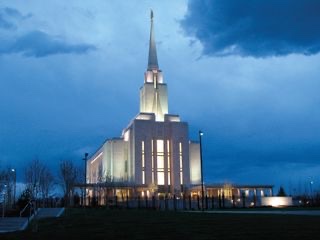
About the time we made it to Phase 4, the temple fully reopened and functional, my family moved to Bluffdale. Temple workers are required to serve in their assigned temple district, and Bluffdale was part of the Oquirrh Mountain Temple district. 

I did not want to go. I did not want to change temples.

At all.

I'm sure there are lots of people who love change and embrace it wholeheartedly. I am not one of those people. I was so happy serving in the Jordan River Temple. I knew people there, I knew how the temple functioned, and I was trained on all the posts. Friday was, indeed, the best day of the week! It was so sad for me to leave.

When they insisted I move, the bishop of our ward expedited the process for me, and I only missed one week between serving at Jordan River and serving at my "new" temple, Oquirrh Mountain. It didn't take long for me to settle in there and feel perfectly at home. There were differences, yes. I missed the size and busyness of Jordan River. Oquirrh is tiny in comparison, and there is much more "down time" for workers. I missed serving as the chapel assistant, welcoming the company to the sessions and instructing them how and when to move to the endowment room. (Only brothers do this at Oquirrh Mountain.)

But I also had new opportunities that I hadn't had at Jordan River, including serving in the baptistry and on the sealing floor, and this past year as Endowment Coordinator. I grew to love that little temple; it became my own. And the lovely people who work there became my "Saturday afternoon friends." 

About a year ago, I sat in our preparation meeting one such Saturday afternoon, next to my friend Tess. As our temple matron began her remarks, she informed us that she would be sharing the final decisions regarding the reorganization of temple districts when the new Taylorsville and Tooele Temples open. Tess lives practically across the street from the Oquirrh Mountain Temple; there wasn't a doubt she and Corby would stay there. She turned to me and whispered, "Do you think you could be transferred?" I had no idea.

Sister Sahm read the names of the stakes that would eventually move to the Taylorsville and Tooele temples. Then she said, "....and the following stakes will be transferred to the Jordan River Temple: Bluffdale and Bluffdale South."

Stunned, I spoke quietly to Tess: "I'm leaving. I'm going back to Jordan River."

It felt surreal. Like one of those "full-circle" moments. Fortunately, I had a full year to process this information and prepare for the change. Last Saturday, April 20th was my last day serving as an ordinance worker in the Oquirrh Mountain Temple. I had spent the previous couple of weeks training a new Endowment Coordinator, so this final day I got to work a normal line assignment, taking me to numerous posts all around the temple, saying goodbye to the many people I would no longer see. And of course I wasn't the only one saying goodbye; there were many quiet, heartfelt glances; sad eyes; and gentle hugs. I was especially grateful for one last opportunity that day to serve in the baptistry; that is the post I'll miss the most. 

Those of us moving to Jordan River have the month of May off. We aren't allowed to begin serving at Jordan until the Taylorsville Temple is dedicated June 2nd. My first day at Jordan River will be Friday, June 7th. And yes, I'm excited! I'm stoked to be returning to my original temple, where I was trained, where I first administered the ordinances. I look forward to reuniting with a handful of people I remember and who are still serving on the Friday afternoon shift.

But the flip side has left me with a few tears welling behind my eyes. Farewell, my "Saturday afternoon friends!"

Maybe one day it won't matter,

But right now, it hurt a little.


Sunday, April 14, 2024

Dissoi logoi: A "truthier" truth

It was over halfway through the Sunday morning session of General Conference nine days ago. I sat in my bed (pajama church for the win!) tears streaming down my face. I had just listened to a message from Elder Patrick Kearon, the newly called and sustained apostle for our church. All weekend I had waited for his talk, but no, I had no idea the intensely emotional effect it would have on me.

As he said, Amen, I whispered quietly through my tears, "I think I have a new favorite apostle."

But no, Elder Uchtdorf, don't you worry! This blog is still named after your October 2013 General Conference talk, "Come, Join with Us." You are still my favorite. Although it takes a bit of an elastic approach to the literal meaning of "favorite," I often say that I'm God's favorite. I truly feel like I am. (Even though I know, of course, that everyone else is too.) That's just the nature of our Heavenly Parents and our Savior; we are all their favorite.

It's like when people ask me which of my five children is my favorite. I usually say, "Whichever one I'm with at the time!" And in the rare event that they are all five with me at the same time, or in the wonderfully frequent event that four of the five are, then they are all my favorite! Though I am still miles away from living the kind of life our Heavenly Parents live, I feel like this is the one way I come closest, and I'll take it! Elder Uchtdorf didn't get replaced as my favorite apostle; he just got a new friend with whom to share the role.

It was Elder Kearon's first opportunity to speak as an apostle to the entire worldwide church, along with anyone else who might be listening. And what did he choose to talk about? Jesus! The radical grace and transformative love that Jesus extends willingly to everyone, every single person ever born, without exception. No barriers. No barricades. No desire to keep anyone out. "No one has built a roadblock and stationed someone there to turn you around and send you away. In fact, it is the exact opposite. God is in relentless pursuit of you."

Huh. Relentless. Well that is good news, indeed, considering sometimes I can be pretty hard to catch. I think it's easy for us to misinterpret certain parts of scripture and come to believe that we must do a bunch of stuff in order to qualify for God's mercy. But if we had to do stuff in order to qualify for mercy, then it wouldn't be mercy! The very essence of mercy is that it's given freely and with no strings attached. Now in case anyone reading this is shouting, "What about James 2:17! 'Even so faith, if it hath not works, is dead...,'" let me clarify. 

The difference between trying to earn grace and living in response to grace, though subtle, is very real. It involves purpose and tone, why we do the things we do and in what spirit. Do we walk the covenant journey, turning back to God when we wander, because we love our Heavenly Parents and our Savior and desire to live in harmony with Them? Or do we do it to display our righteousness and lift ourselves higher, which often leads to judgment?

Elder Kearon taught us that "God wants for us a radical reorientation of our selfish and prideful impulses, the eviction of the natural man, for us to 'go, and sin no more.'” This desire is completely inclusive. As he spoke these words, I couldn't help but think of Nephi's teaching that "there are save two churches only; the one is the church of the Lamb of God, and the other is the church of the devil” (1 Nephi 14:10). To me, that means that everyone, whether they know it or not, whether they understand it or not, is part of the church of the Lamb. Elder Boyd K. Packer taught way back in 2004 that "...everyone, no matter where they live or what they believe or what they do—has within them the imperishable Light of Christ."

Everyone. Christians and those of other faith traditions, believers and atheists, those who have never heard of Jesus and those who strive with heart and soul to follow Him. "Everyone" is a universal symbol of inclusion. If Nephi and Elder Packer are correct, then only the tiniest, most infinitesimal number of folks who truly worship evil and seek to perpetuate it make up the church of the devil; everyone else is part of the church of the Lamb of God, guided by that "imperishable Light of Christ."

When we understand and acknowledge that everyone we meet is part of Christ's church, we're less likely to cling to tired and exclusive language like, "I know this is the only true church on the face of the earth," which inaccurately, yet often convincingly, implies that ours is the only church with any truth at all. Instead, we seek for common ground, mutual appreciation, and a desire to learn and progress together with those of other faith traditions as well those with no faith tradition at all. To use a fave LDS phrase, "With real intent," we seek to learn from others around us, regardless of their background, lifestyle, religion, political affiliation, culture, race, gender, or sexual orientation. We recognize that their truth might add to and strengthen our own. 

In doing so, we engage in a process the Greeks called "Dissoi logoi." I teach this to my Intermediate Writing and Rhetoric students as they prepare to write their final essay, one traditionally referred to as the "Argument Essay." In their past educational experiences, most were taught that their goal for this "argument" genre is to make a statement of opinion backed up by claims with evidence to support them, then acknowledge counter-arguments, with the sole purpose of shutting them down! As we lean into Dissoi logoi, we seek instead to find common ground with those who hold opposing viewpoints, double arguments so to speak, as we ask ourselves "What elements of truth can I find within these opposing viewpoints that would bring all of us to a "truthier" truth?"

How cool is that!? 

And how can we apply it to our intentional, ongoing study of the gospel of Jesus Christ?

So what were my takeaways from last weekend's General Conference? There were many, many, but I will share a few as I conclude:

  • The covenant journey is worth the struggle of every step, because the Savior of the whole world wants to walk that covenant journey alongside me. I'm His favorite.  
  • I have a new favorite apostle. His is name is Elder Kearon, and he preaches Jesus, Jesus, and more Jesus, with the coolest British accent, and he's also hilarious ("Behind every new Apostle stands an astonished mother-in-law.")
  • Elder Uchtdorf is still my favorite too.
  • The guy who spoke following Elder Kearon had the most challenging position of the weekend, and he totally crushed it. As Elder Kearon concluded his remarks, Gerald said something like "I wouldn't want to have to follow him." I'd be lying if I said I agree with that statement, because speaking in General Conference would be like a fairy tale dream come true for me, regardless of the speaking order, but I did understand Gerald's sentiment. 
  • Oh, and the guy's name, the one who spoke after Elder Kearon, is Elder Brian K. Taylor, and his tender teaching on how, even in times of intense adversity, we may be "swallowed up in the joy of Christ" was freakin' on point! No downplay of the tragedies and pain mortality brings. No "Everything happens for a reason" babble. Just the testimony that the right answer and the only answer to life's tragedies is Jesus.
It is always, always Jesus.

Tuesday, March 19, 2024

You don't have to be Nephi.

Don't get me wrong. I like Nephi. I really do. He exhibits tremendous faith and unparalleled perseverance in the most dire circumstances. The thing is, I keep waiting for him to be human, to make a mistake, to doubt his faith, to do anything that isn't absolutely perfect. 

As a result, I find myself relating far better to Laman and Lemuel than I do Nephi. I can connect with them; they seem real. Cuz I make mistakes all the time. I doubt my faith. I lack the emotional strength to make hard decisions. I doubt some more. I am quick to take offense and slow to forgive. I am self-absorbed and insensitive to others' needs. I am judgmental. I gossip. The list goes on. Does Nephi share any of these struggles? We don't know.

Now to cut Nephi some slack, keep in mind that he is the one writing the story. I suppose if we were writing our own stories, we'd present ourselves in the most positive light. It makes sense. And if his purpose is to bear testimony of the divinity of Jesus Christ and God's eternal plan for our happiness, he does a fabulous job! As I've prepped for "Come Follow Me" lessons in 1st and 2nd Nephi these past few weeks, I've been renewed with spiritual strength as I've pondered the love of the Savior and the lengths he'll go to in order to be exactly that. Nephi preaches Jesus eloquently, and I have feasted upon his words these last couple of months!

But fortunately, I don't have to be Nephi in order to receive Jesus' love or to be transformed by his grace as it pours freely over me and my life. And neither do you. You can be Thomas, the doubter. You can be Peter, the denier. You can be Paul, the persecutor. You can be Alma the Younger, the wicked doer. You can be the Woman at the Well, Laman and Lemuel, even David, the murderer and adulterer! Not that you should be, of course. Absolutely don't do those things! But the point is, God uses imperfect people to do great work, and Jesus loves us and saves us no matter what. Jesus doesn't love us because we're good; Jesus loves us because he is good. And he's already paid the price for our salvation. He reaches out with arms wide open and says, "Come unto me, all ye that labour and are heavy laden, and I will give you rest" (Matthew 11:28).

I fear sometimes we forget this. Or we're misguided by an incomplete or inaccurate reading of specific scripture referencers taken out of context. For example, the second part of 2 Nephi 25:23: "...for we know that it is by grace that we are saved, after all we can do." This could lead us to feel like we have to work hard to earn our salvation, or (worse!) that Jesus will only help us after we've expended every last fraction of our time, effort, and energy trying to solve our problems ourselves. Nothing could be further from the truth. I mean seriously, what did Paul ever do before Jesus jumped in to rescue him on the Road to Damascus? Or the woman caught in adultery? Or the thief on the cross? Or countless others? Jesus wants to enter our stories in the middle of the messiness, in the utter chaos that is our lives, in the midst of doubt, fear, bad choices, and confusion. I think that's where He does His best work! 

So what about that scripture in Nephi? Some tell me that the word "after" actually means "in spite of." "...for we know that it is by grace that we are saved, [in spite of] all we can do." I like that a little better. The phrase "in spite of" suggests that we can never do enough, and that is certainly true. Humans could spend 100+ years striving to do all they can, failing miserably, and forever stressing over whether they've done enough, while the answer is right in front of them: knowing the "source to which they may look for a remission of their sins" (2 Nephi 27:26). 

A second way to look at 2 Nephi: 25:23 (and my favorite!) is to consider it in the context of its surrounding narrative. I just stopped writing this post and counted the number of times Nephi counsels his audience (us!) about what they need to do in order to inherit the Kingdom. He exhorts his readers to "believe in Christ" or "believe on His name" 10 times, just in the handful of verses surrounding verse 23. It seems pretty clear that "all we can do" is believe in Christ. He is the eternal enabler and the only One capable of healing the broken, redeeming the lost, and empowering the willing.

And that kinda leads to a final thought regarding the well-known verse in James 2: "...faith without works is dead." Indeed, we cannot earn grace. God's grace is fully undeserved and, in fact, already ours! What we are called to do is to live in response to grace. I witness this all the time, don't you? It's manifested in the goodness of fallen, imperfect people, in our church, in other churches, and in no church at all. John 1:9 teaches that Jesus "was the true light, which lighteth every man that cometh into the world." When a child comes running full speed to pet my dog and delights in the joy of animals, I see it. When a young man takes his great-grandma's arm and helps her into her home, I see it. When citizens attend their precinct caucus meetings and actively participate in the process to shape government, I see it. When a sleep-deprived mother gets up for the 14th time in the night to comfort her infant, I see it. All these and countless others are examples of imperfect people responding to the light within them.

So back to Nephi. Dude, I look forward to meeting you one day. I want you to tell me the stories of your life, including your struggles, your mistakes and what they taught you. I wanna know you're human. And I want to thank you with all my heart for writing the record of your experiences and your steadfast testimony of the God I know: the God who saves, the God who weeps, the God who rescues, the God who enters our stories wherever we are, the God who offers radical grace, and the God who loves with might greater than we can possibly comprehend.

Sunday, April 9, 2023

The Son shone brightly this Easter morn!


For those of us in the Salt Lake Valley, it's been a long, hard winter. Yes, I lived in Montana for seven years, where winters could be even more challenging, but in my 12 years here in Utah, I've never experienced such relentless cold or never-ending snow. Every time we dared to think "Maybe this is the last big storm," another arrived. As recently as last week, we had over foot of new snowfall, closing our local school district yet again and triggering my driving anxiety. Yet again!

But this Easter morn, the Son shone brightly!

Guys! It is such a beautiful day! As I walked into church, wearing a short-sleeved dress and no coat, I couldn't help think about the first Easter morn, when after three days of what must have been crippling grief, Jesus's followers awoke to a beautiful day. Their Lord had risen, culminating the most miraculous event in human history, and the most impactful. The Son shone brightly that Easter morn.

....as it does today. For us! Easter reminds us that hope is ours for the asking. It is freely given, and received by anyone who desires it. 

Even after the snowiest winter, because of the Son, the sun will shine again.

Through the most tumultuous storms, whether literal or figurative, because of the Son, calm will come.

They say time heals all wounds, but that is not true. Jesus heals all wounds. Absolutely all of them.

Not that I'm wishing time away, because I'm definitely not. I actually find myself regularly wishing time would slow down. But I do look forward with excitement to the end of this year when we get to study the extremely cool book: The Revelation of St. John the Divine, which includes one of my most favorite references:

"And the city had no need of the sun, neither of the moon, to shine in it; for the glory of God did lighten it, and the Lamb is the light thereof. And the nations of them which are saved shall walk in the light of it: and the kings of the earth do bring their glory and honour into it" (Revelation 21:23-24).

You know, had Easter come any earlier this year, we would have had some snowy Easter egg hunts. And that would have been just fine too because, as the above scripture promises, we have no need of the sun to lighten our lives, if we invite the Son to do so. 

Still, I like to think God looked down upon all of us here in the valley, and with infinite grace, sent us spring, just in time for Easter.

The Son shone brightly this Easter morn!

I am grateful.


(Early Happy Birthday to our favorite Isaiah, who will be working in Las Vegas next week on his actual birthday!)

Monday, April 3, 2023

Tears of Sadness

Let me begin by saying that, for me, this was the best General Conference in recent years. The Palm Sunday/Easter focus, the outreach/gathering focus, and most importantly, the cumulative Christ focus were unparalleled. I sat for nine hours and soaked it in. Every word, every hymn, every prayer pointed me closer to the Savior and His infinite love. I closed out the weekend feeling joy, hope, and inspiration to go forth and do His will.

Saturday evening, Amanda, Eli, and I watched the session together in our basement. That's where we have the biggest, nicest TV, a cozy sectional couch, warm blankets, and soft lighting. Snacks in hand, we gathered to listen and learn. 

During the final talk, I noticed tears in Eli's eyes. He was fighting hard against them, but come they did. I had no idea why. When the talk ended and also the session, Eli declared: "That one really got me."

"Why?" I asked.  

The talk by Elder K. Brett Nattress of the Seventy began with his testimony that our Heavenly Parents and our Savior love us and always remember us. Then he asked, "Do we always remember them?" He followed up by telling the story of a young man he once knew. Danny had been raised in the Church, and at some point got lost in the chaos of drug addiction, particularly methamphetamine. His life spiraled out of control for awhile, but ultimately, he chose to get the help he needed to overcome this challenge. At one meeting with his bishop, the bishop said, "Danny, I think we should talk about preparing your papers to serve a full-time mission."

Danny: Oh, Bishop, I would love to serve a mission, but you know the things I've done. I'm afraid I've lost that opportunity.

Bishop: Well, I don't know for sure, but let's try and see what happens. If it turns out you are excused, you will know that your desire was to serve the Lord, and you did all you could.

A few months later, Danny received a letter in the mail from the First Presidency of the Church with his call to serve a full-time mission. He served faithfully for 24 months, returned home, married, and is now raising a family of his own in the Church.

This was a touching story of the absolute central message of the gospel, and it warmed my soul to hear it; however, I still didn't understand why it had been such a trigger for Eli, whose story was nothing like Danny's.

He proceeded to explain.

"Mom, all I could think about was my friend Jack [name changed]."

Jack, too, was raised in the Church and became sidetracked during high school with alcohol and marijuana. Like Danny, Jack eventually decided he no longer wanted that life; he wanted to change! He went to his bishop for help and told him that one day, he would like to serve a mission. The bishop's words stung this young man to his core:

"Oh, you won't ever be approved to serve a mission, after your behavior."

I watched Eli's heart break for his friend, whom he hasn't seen in a decade. I, as well, have fond memories of Jack, transporting him and Eli to and from sports events and choir activities during middle school, seeing him at church occasionally, though he wasn't in our ward. My heart breaks for him all these years later.

I'm grateful for bishops like the one Elder Natteress described in his talk, one who believes in the healing, transformative power of the Savior's atonement; one who tries to love as Jesus loves; one who looks at a kid and sees his divine potential, rather than his past mistakes. We have a bishop like that in our ward. One of his favorite lines is "You can't mistake your way out of the redeeming love of your Savior."

I'm grateful for bishops like that.

Friday, October 21, 2022

"For the Strength of Everyone": My thoughts on October, 2022 General Conference

It's been three weeks since General Conference, and I'm only now drafting my post about it. Why the delay? Like everyone, I'm busier than I'd like to be. My dream world would include limitless time to read, write, and walk, but alas, household responsibilities and a job worm their way in, and rob me of my precious reading and writing time. (I'm a fanatic about walking; nothing impedes that.) I also needed time to think about what I would say, time to process the talks and focus on what resonated most with me as well as reflect on their significance to the world at this time. This process continues indefinitely, but I think I'm ready to put words to a few of my thoughts.

First, I so loved Elder Bednar's talk on "The Parable of the Wedding Feast." Exegetical discussion of scripture is my favorite, and Elder Bednar did a fabulous job explaining the spiritual truths in this parable. I was mesmerized! To be "chosen" is NOT an exclusive status. We all can "choose to be chosen," as we honor our covenant relationship with God. Hooray!

I was also grateful for Elder Renlund's talk as he reminded us that "with the help of the Holy Ghost, we can transform ourselves into the beings God intends us to be." Consider the power in those words! The covenant relationship that began with Abraham and Sarah and their little family so long ago is now ours. It is personally transformative and the sole means by which we realize our divine lineage and potential. Elder Renlund was also clear about our sacred responsibility to seek and receive personal revelation for our lives as we move through our own covenant journey: "Leaders may guide and give counsel, but choices and decisions belong with us." Woo!

Happiest of all was I, when Elder Uchtdorf announced the revised "For the Strength of Youth" pamphlet. Truth be told, I have always disliked that particular document, so much so that I basically ignored it as I raised my teenagers and considered it only slightly when I served in a Young Women's Presidency. The rigid rules and legalism in the former version of the pamphlet did nothing to strengthen my testimony, deepen my conversion, or help me feel yoked to my Savior, and if I felt that put off by the language and tone, imagine how our sweet young men and young women might have felt.

But guys!!! This new one is splendidly different! It doesn’t make choices for us, but focuses on the "doctrine, foundations, and values" to guide our choices. It points our youth not so much to rules but to the only source where they can find true hope....their Savior, Jesus Christ. "And we talk of Christ, we rejoice in Christ, we preach of Christ, we prophesy of Christ, and we write according to our prophesies, that our children may know to what source they may look for a remission of their sins" (2 Nephi 25:26).

Time with our youth is limited and so precious. Shoulder shaming our adorable young women and preaching againt tattoos to our awesome young men seem like sad and unproductive uses of that precious time. Surely there are other principles more worthy. What if instead we asked them to reflect upon what living a covenant life might look like, knowing it will look different for each of us? Or what if we asked them to consider what they already know about the character of their Savior and how remembering His goodness and power and love might sustain them in the darker periods of mortality? Or what if we shared how we have used His healing atonement in our own lives to carry us when we couldn't walk on our own?

Surely discussions such as these would strengthen our youth and nurture their conversion process way more than inconsequential, culturally-specific stuff like hemlines, earrings, tank tops, and tattoos.

This revised pamphlet refocuses us on the only true source of strength: Jesus!

And that, my friends, is "For the Strength of Everyone!"


Thursday, April 14, 2022

"Stay for the whole feast, even if you're not sure about the broccoli."

It was my favorite line from General Conference.

I didn't get to hear it live. I was at a baby shower for a dear friend on Saturday and then busy all week with teaching and end-of-semester grading. It wasn't until four days ago that I blocked out some time to watch both Saturday sessions. My two favorite talks came one after the other during the Saturday afternoon session: first, Elder Jeffery R. Holland's "Fear Not: Believe Only!" followed by Elder Patrick Kearon's "He is Risen with Healing in His Wings: We Can Be More Than Conquerors."

Yesterday, I substituted for a seminary teacher at Mountain Ridge High School Seminary in Herriman. As I took roll, I asked students to give me their favorite line from General Conference, not their favorite talk, but their favorite line. One cute sophomore mentioned a line from Elder Andersen's talk: "Peacemakers are not passive; they are persuasive in the Savior's way." She explained how she tries to be a peacemaker within her group of friends, not by withdrawing from their drama but by seeking to bring the light of Jesus into the chaos, through her own calmness. Another young man shared a line from Elder Bednar's talk "But We Heeded Them Not" and explained that he relies on the Holy Ghost to bring clarity to his judgment as he seeks to "heed not" various temptations in his life. Are you impressed? Same. Teenagers are so much better than us at zeroing in on the truth, raw and real, and its relevant applications. That's why I jump at the chance to teach seminary whenever I can.

My personal favorite line from Conference weekend came from Elder Holland's talk and became the title of this post. Let me first explain that I hate broccoli. Really, I do. I wish I liked it because it's high on every single list of food that's good for us. But alas, the smell is enough to turn my stomach, and even raw, I think it's gross. So Elder Holland chose the perfect vegetable for his beautiful metaphor. Surprising? Nope. He is a rhetorical genius.

But why this line? Well you see, I plan to stay for the whole feast. I'm not going anywhere. I'm all in. That doesn't mean that I don't ever have questions, doubts, struggles with doctrine, sometimes even struggles with the way our leaders interpret the doctrine. I am human, blessed with the capacity to think, to wonder, to speculate. I study. I pray. I seek answers. I search out revelation for my own life. I don't always receive it, but sometimes I do, and for both outcomes, I am grateful. The latter gives me clear direction, and the former challenges and strengthens my faith.

I am blessed with the opportunity to serve in the Jordan River Temple every Friday afternoon as an ordinance worker. Our shift coordinator always opens our prep meeting with "Welcome to the best day of the week!" Oh, she is so right about that. There is nothing better than being in the temple. A couple weeks ago, I sat in the temple cafeteria during my 20-minute break and listened to a discussion between two older sisters. Addressing the importance of heeding prophetic counsel, one sister commented, "In my family, when the Prophet speaks, the discussion ends." This sweet sister has taught me much in the time I've known her, but this comment left me confused. Troubled even. Because in my family, when the Prophet speaks, that's when the discussion begins! That's when we start the process of pondering and praying to understand what his counsel might look like in our individual lives. It will look different for each of us, because we are different. Sometimes we process the Conference talks by ourselves, in our own ways and in our own timing. But oftentimes, we share our thoughts, either in person or in family text threads. I love learning from my children, hearing their perspectives on the messages. Yes, when the Prophet speaks, the discussion begins!

I'm grateful for a gospel that honors my moral agency, one that doesn't ask me to blindly obey, but to search and study and struggle on my own, with my family, and with my ward family. Wrestling with scripture, as well as with modern-day counsel and revelation, is what leads to increased depth and breadth of understanding. We don't understand everything, and I don't think we ever will in this mortal journey. And that is okay. The process of becoming who we are meant to be is long, and not without hills and valleys, mountains and seas. But be assured; we are promised everything! We are promised all God has, if we will do our best to be faithful and endure. As we study "Come Follow Me" this week, let's look at what the God of Israel promises. Humor the English teacher for a second, and look at the verbs: 

The God of Israel will fight for us (Exodus 14:14), provide for us (Exodus 16:4), heal us (Exodus 15:26), and fill us full (Exodus 16:12). The God of Israel promises to always be with us, and ultimately, to deliver us. Through a covenant with one little family, nations are blessed. Through their faithfulness, the gospel of hope springs forth and floods the earth.

Yes, Elder Holland. I will stay for the whole feast, even if I'm not sure about the broccoli.

Monday, April 11, 2022

"Mom, I just really miss church."

This was part of a conversation I had with Seth on our daily walk around the neighborhood yesterday. And of course, it warmed my very soul. As parents in the church, we long so desperately for our kids to gain testimonies of the gospel, firm ones that will sustain them through all the trials they will face in life. Above all else, we want their happiness, and we know that is best achieved through strong, unwavering faith in their savior. So we try hard to foster that faith.

Our efforts aren't always enough, though. No matter what, it feels like we can never do everything we need to do. When we have several children, we struggle to meet all their diverse needs, and sometimes that's literally impossible. Someone, it seems, is always disappointed. I don't know much about how dads feel, but I understand "mom guilt" to its very core. "Maybe this happened because we don't hold FHE regularly enough. We do it often, but not always." "Or maybe that happened because we suck at that all-important family dinner, the one where everyone sits at a table at the same time and shares his or her day, the one that prevents your children from becoming drug addicts.

Truth is, most parents are doing their absolute best. Most of us don't get up in the morning and plot out how we can ruin our children's lives. Yet every last one of our children could easily find himself in therapy one day because, somewhere along the line, a critical need got missed. There were only two Perfect Parents, and last I heard, even they lost 1/3 of their kids.

That said, two occasions in particular demonstrate that our precious offspring have found their faith, that they no longer rely solely on our testimonies or "borrowed light" as we like to call it. One is when we send them off on missions, and another is when we sit next to them in the temple as they are sealed to their spouses. I've had the privilege of doing the former three times and the latter twice. Hardly anything compares to those experiences.

But Seth's mission didn't end as we expected. After serving just 19 months, his mission was abruptly halted because of COVID-19, when all North American missionaries serving in Paraguay were sent home. Those like Seth, who had served over 18 months, were permanently released. Their missions were over. Seth handled all this very well, much better than I did, but it wasn't (and still isn't) easy. He came home to 14 days of quarantine inside our house, followed by social distancing and sheltering in place. And so it's been for the last seven weeks. He can't hang out with friends. He can't date.

And he can't attend church. Imagine spending 19 months teaching people the importance of church attendance, and then not being able to do that, himself.

Fast forward to today, April 11, 2022. It was May of 2020, when I wrote this post; I just never got around to publishing it. I want it preserved, so I'm gonna post it today, nearly a year late, but probably not share on social media. Suffice it to say that COVID is far better controlled now than it was then, and I'm happy report that Seth, and all of us, are once again able to attend church in person.

You too! Always remember that! As Elder Uchtdorf told us, "There is room for you!"


Saturday, April 20, 2019

The True Meaning of "Modesty"

Recently, a friend took her 4-year-old daughter to kindergarten orientation at her neighborhood elementary school. At one point, the children were taken to a different room to play, so the parents could receive instruction from the kindergarten teacher regarding how to prepare their kids for school. This part of the meeting lasted maybe 20 minutes, and other than a brief nod to the importance of kindergartners being fully bathroom independent, the entire 20 minutes was devoted to the dress code, specifically, acceptable dress for little girls.

Girls are not allowed to wear tank tops unless they are thick enough that their shoulders are covered, and if they wear shorts, the shorts must be knee length when the girls are seated. 

Seriously? These are 5-year-olds we're talking about! This is an elementary school. The oldest girls are turning 12. I'm confused on so many levels; I barely know where to begin.

First, I can't figure out the need for a dress code in an elementary school. I just can't. Kids should wear comfortable play clothes, weather appropriate. In August, that will likely include shorts and tank tops. Shorts, by definition, are short. They don't go down to the knees. Tank tops do not cover shoulders. Of course not.

Second, if leadership in elementary schools feel they need a dress code, why is it targeted only at females? There was zero discussion in this meeting about what boys should wear. For example, are there restrictions on images or words printed on t-shirts? If so, what are they? 

I worry all this might be the result of our church culture seeping into the public schools here in Utah. I hope not, but yes, I wonder. Our church culture tends to emphasize the word "modesty" a lot, often to persuade girls (primarily) to dress in ways that cover more of their bodies. In reality, "modesty" has little to do with dress specifically; instead, it has to do with humility vs. pride. It is an attitude. If we are modest, we don't seek to draw attention to ourselves. We focus outward, on loving and serving others. We don't flaunt our wealth or our beauty or our possessions. 

In Biblical times, Paul used the word "modest" to mean appropriate or comely. We should act and dress appropriately for the various occasions of our lives. 

This begs the question: Who gets to decide what's appropriate? I remember last summer sitting under a tree at a water park, resting, after multiple trips up and down the slides. I do love water slides! I was dressed in a tankini bathing suit. It had spaghetti straps, a top that revealed maybe an inch of my stomach, and board shorts that hit mid thigh. I had spent two hours running up stairs and sliding down slides, alongside dozens of people, both women and men.

Was I dressed appropriately for the occasion? Yep. Was I modest? Indeed. I had zero desire to draw attention to myself or to show off my hot, sexy body (yeah, right!); I was simply wearing the best option for a water park. Would my tankini bathing suit be an appropriate choice for work? Dumb question. So you see, it isn't that certain types of clothing are inherently immodest; it has to do with the reason behind our choices (humility vs. pride) and the appropriateness to the occasion. 

In our church, many families choose to teach their children to wear clothing they would be able to wear once they make temple covenants as adults. Let me go on record to say that this is perfectly okay. Teach your children what is in your heart. We are all doing our best and no one parents perfectly. As long as you teach and guide with love, if you want your children to dress from infancy as though they were temple endowed, that is absolutely okay.

What is not okay is to judge other church members who don't make this same choice. Like me. My kids wore normal, perfectly acceptable clothing. In hot weather, they sometimes wore shorts and tank tops. At swimming pools, they wore swimsuits, for the boys, swim trunks that left their entire upper body exposed! My daughter wore shorter skirts and strapless prom dresses. In the winter, they all wore sweaters, long pants, and coats. Were my children modest? Always. Their clothing was appropriate for the occasion, and their goal was not prideful.

Unfortunately, that wasn't good enough for some church members. They didn't judge my sons so much, but my daughter was often shamed by well meaning but woefully misguided church leaders and members, who felt her clothing wasn't "modest" enough. You know what? That wasn't their choice to make. It was mine, my husband's, and my daughter's. She even received an anonymous letter, implying that, because of her clothing, she would never be able to find a husband who would want to marry her in the temple. Nope, I couldn't make this stuff up.

This is dangerous territory, my friends, and equally dangerous is suggesting to kindergartners in public elementary schools that their shoulders and knees are "immodest." Even if we use the term "modest" to mean covering up one's body (I would never use it this way, but just hypothetically), it's dangerous to use it in relationship to young children. Kids can't be immodest. It's impossible. If you are having sexual thoughts about children, you have a problem. Get help. But don't make silly rules about shorts and tank tops for elementary school kids.

Finally, those of you who choose to have your children dress as though they were temple endowed, please, please teach them not to judge others who don't make the same choice. My daughter remained active in the church and ultimately married in the temple. Turns out her testimony was stronger than the shaming she encountered. For many girls, it wouldn't be.

I'd love to tell my friend's little girl that she'll be welcome at her new school come August, wearing her normal play clothes. I can't. I'm not in charge. What I will say is whoever you are, and whatever you wear, you are welcome in my church. We open our arms to everyone. 

As President Uchtdorf proclaimed, "There is room for you in this church."


Tuesday, October 16, 2018

Add a hyphen, and use a lower-case "d." Please!

Change isn't my favorite. Even when I know it's for the best, I prefer the familiar. I love knowing what to expect and for things to go according to plan.

So imagine my dismay when three weeks ago, our stake boundaries were reorganized, our ward was obliterated, and I was transplanted into an entirely new ward. Then, one week later, at General Conference, our prophet announced a significant change to our Sunday meeting schedule; beginning in January, our block of meetings will be just two hours, rather than three. Wait, what? All these changes all at once? Has everyone forgotten that my baby is in Paraguay, and I'm already trying to deal with that, which means I no longer have a kid in high school, and he's not even just a state or two away at college; he's 5,720.042 miles away! And still, they throw all these other changes at me.

Then, if that isn't enough, there's this other troubling issue. Another focus of President Nelson recently is to get people to use the full and correct name of our church, rather than abbreviations such as the "LDS Church" or nicknames such as the "Mormon Church." Truth be told, at first this seemed pretty insignificant to me, but then I listened to President Nelson explain his thoughts on the issue when he addressed the membership in Conference, and it helped me understand a little better. Then I remembered the murderous thoughts that filter through my brain whenever I hear someone nickname one of my own precious kids. (Just watch me turn violent if anyone dares call Shulamith "Shula" or Isaiah "Izzy.")

So maybe Christ would prefer his church be called after his name, the name he told us to call it (3 Nephi 27). Yes, it's a mouthful, but I'm beginning to understand.

As a result of this directive, members everywhere are making small but significant changes here and there to replace the abbreviations and nicknames with the correct name of our church. The problem is, many of them don't know how to spell it. Calm yourself, Terrianne. Breathe. Yes, I'm trying. Really I am, but everywhere I look, I see the name of our church misspelled.

Can we be clear. The official name of our church is The Church of Jesus Christ of Latter-day Saints.

Note the hyphen between "Latter" and "day." Note the lowercase "d." Whew! We've got this.

If we omit the hyphen or capitalize the "D," we refer to (respectively) two tiny splinter groups who broke off years ago and are no longer in any way associated with our church.

So we really don't want to do that.

When we proclaim as Presdent Uchtdorf did, "There is room for you in this church," let's be sure we are welcoming people into our church, The Church of Jesus Christ of Latter-day Saints.

Thursday, July 19, 2018

Mere Mortals, Divinely Appointed


On occasion, former CNN talk show host Larry King interviewed former LDS President, Gordon B. Hinckley. One such interview happened in 2007. I remember so vividly sitting in my friends' living room, eagerly awaiting the words of a man I revered so highly.

I was not disappointed.

Larry King is a kind, easygoing type of guy, always respectful, a great fit for President Hinckley. The two of them covered many topics through the course of their interview, including the former Priesthood ban on black men of African descent. When Larry King asked the prophet to explain the reason for that ban, he calmly and cheerfully replied, "It's the way early church leaders interpreted the doctrine."

This response leaves room for various interpretations, one being the possibility that the early leaders interpreted the doctrine incorrectly. Maybe they were just wrong.
                                                                                                           
What a wonderfully liberating idea! Maybe they were just wrong.

In our church, we raise our right arms to the square to sustain members to many different positions. We sustain someone called to be a nursery leader. We sustain someone called to be a relief society greeter. We sustain someone called to be a Sunday School teacher. In like form, we sustain those chosen to be general leaders of the church, including the 12 apostles and members of First Presidency.

When we raise our arms to the square to sustain our brothers and sisters, we offer our support. We promise to do all we can to help them in their callings, to ease their burdens, and to pray for them. We promise to follow their leadership, whether they are leading the youngest among us in the nursery or serving in positions of leadership for the worldwide church.

What we do not do when we sustain these people is imply in any way that they are perfect. All of them are human beings, living in a fallen state, striving to do their best, but yes, falling short on occasion here or there. Each of them relies solely on the infinite atonement of Jesus Christ, without which not a single one of us could make our way back to our Heavenly Parents.

That includes the general leadership of the church. This may seem obvious. However, one unfortunate thing that sometimes happens in our church is that we forget that our general leaders are human beings. We come to believe, expect, even require them to be perfect. Those outside our faith sometimes accuse of of worshiping Joseph Smith. We don't, of course, any more than we worship our current president, Russel M. Nelson. But I think the reason some may think we do stems from this tendency to deify our general church leaders.

When we deify our prophet, his counselors, or members of the Quorum of the Twelve Apostles, we do a huge disservice to both them and us.

For them, it creates an impossible environment in which to work. Imagine feeling that you have to be perfect or others might lose their testimonies and fall away from the church, yet knowing full well you can't be. What ridiculous and unproductive pressure to place on these poor servants! They devote their lives to building the kingdom, serving tirelessly and relentlessly, often at advanced ages, all on our behalf. Can we cut 'em some slack? They're mere mortals, with the same struggles and temptations, conflict and strife as you and me. With their overwhelming responsibility, I'll bet they are profoundly grateful that on those occasions that they miss the mark, make a poor decision, or move in the wrong direction for just a second, they have the glorious doctrine of repentance on which to lean. They can go to bed with the assurance that tomorrow is another day, and that their savior suffered in a garden and died on a cross to make it possible for them to try again.

For us, deifying our leaders, whether general or local, can lead to a dangerous slippery slope of hero worship, that's neither productive nor real. I have a friend who joined the church along with her husband early in their marriage. Their stake president at the time was pivotal in their process of investigating the church, taking the missionary discussions, and ultimately choosing to be baptized. I think he might have even baptized them himself. A few years later, he made some unfortunate choices in his life that led him to leave the church entirely. What if my friend had believed this leader to be perfect? What if her testimony had been based on this man, rather than on her savior? She might have left right along with him, rather than serving faithfully in the church all these years, raising a lovely family of four children, and sending three of them on full-time missions.

I have tender memories of Seth in the nursery, marching around holding a flag or banner of some sort, joyously singing "Follow the Prophet; he knows the way!" The obvious question is how do we follow our leaders, fully sustain and support them, without falling into the trap of believing they are incapable of human error? I don't have a perfect answer for everyone (and I don't have to), but I can tell you what works for me.

First, I can sustain church leaders with heart and hand. I can pray for them to lead according to the Father's will and work alongside them to build the kingdom.  Second, I can listen to their counsel, honestly listen to it, with an open mind and heart. I can pray to seek ways that counsel might apply to me personally and to my  family, rather than brushing it aside. And third, I can remember that they are human beings, mere mortals, striving to follow their savior just like me, but divinely appointed to lead at this time.

May I end by quoting Elder Dieter F. Uchtdorf, whose words happen to be the general title of this entire blog:

"And, to be perfectly frank, there have been times when members or leaders in the Church have simply made mistakes. There may have been things said or done that were not in harmony with our values, principles, or doctrine. I suppose the Church would be perfect only if it were run by perfect beings. God is perfect, and His doctrine is pure. But He works through us--his imperfect children--and imperfect people make mistakes."

Yep, Elder Uchtdorf; you are correct: "There is room for you [and me] in this church."